Showing posts with label Japan. Show all posts

Tuesday, March 15, 2011

Massive disasters... and small gestures


A colossal natural disaster has struck Japan and as the world looks on and rallies around to help the stricken nation, the relationship between neighbours Japan and China is put in the spotlight.

When there has been strong animosity between two nations for many years, what happens when one of them is subject to a devastating natural event that causes loss of life on a huge, almost unimaginable scale?

When an earthquake struck Sichuan province in 2008 claiming the lives of around 90,000 people, China made the unprecedented move of accepting foreign help. Especially symbolic was the granting of permission for a Japanese team to join the rescue effort. They were first Japanese troops to set foot in China since World War Two.

The Japanese team did not locate any survivors (they were not allowed in until late into the operation) but they were thanked by Premier Wen and for many in China it was a small but meaningful gesture that (combined with an estimated 9 million USD in aid) hinted at the possibility of improved relations in the future.

Now the situation has been reversed. Some estimates have put the loss of life caused by the Sendai earthquake and tsunami at near Sichuan levels.

The Chinese Premier has expressed condolences and dispatched a 15-man rescue team. Aid of around 4.5 million USD has also been pledged.

Considering the scale of the disaster, it's not a lot. Yet even this contribution is more than what many Chinese would have offered Japan.

Such is the deep-rooted hatred felt towards the Japanese people amongst some Chinese, that some were openly celebrating the Sendai earthquake - cheering as though the event were some kind of moral or national victory.

Blog sinostand trawled the web as the tragedy in Japan unfolded and found some choice quotes (after initially finding many messages from people imploring their fellow Chinese not to celebrate the disaster):

“Japan earthquake, tsunami, oh ha ha ha ha ha. Brings satisfaction to everyone! Retribution, retribution ah!”

"We’re not small like Japan because we’re human beings, not pigs. Let little Japan suffer this little holocaust."

"Japan’s earthquake is worth celebrating. We should gloat. In the face of natural disasters, people are a country. Japanese people do not deserve sympathy. Give up the Diaoyu Islands, change the textbooks, then nothing will be wrong."


The last comment illustrates the source of these sentiments: war time atrocities and territorial disputes.

The writer of that article believes about there is a constant 20% of Chinese that hold these hard-line, anti-Japanese sentiments and that they run through all sections of Chinese society regardless of age or level of education.

The Japan Times published an article on Feb 27th 2011, just days before the disaster, in which a writer in Chengdu describes the deep-rooted mistrust of Japan amongst university-age Chinese. Its central quote is:

"What you must understand is we Chinese all hate Japanese."


heard by the author at a debate amongst students at Sichuan University.

Now that the full scale of the Japan disaster is unfolding, perhaps these views are not being expressed as openly but the lingering animosity is unlikely to go away.

A rescue team here, a few million dollars there. When disasters of such magnitude only result in such relatively small gestures, is there really any hope that these two countries will one day reconcile and put past differences aside?

Perhaps they are just the first, tentative steps in improving relations between the two countries? If only we didn't need huge tragedies and thousands of deaths to instigate them.

Story: Global Times

Story: International Business Times


Friday, January 21, 2011

A complete guide to sushi etiquette

I'm sure that like me, many readers enjoy eating sushi. But are you aware of the many customs and rules that go along with this cuisine?

Exactly how much soy sauce should you use? Precisely how much wasabi? What should you say (and not say) to the chef when ordering?

Watch this helpful short film to find out the answers to these and many other questions.


PS This film may not be entirely serious ;)

Monday, May 17, 2010

Use a rice cooker to make bread!


Yes, it's true! I saw it on the internet!

Apparently if you own a modern rice cooker i.e. one with a timer function, not the old fashioned ones that that just have an On/Keep Warm button, you can actually 'hack' it to turn it into a breadmaker. And if people's comments are to be believed, the results aren't even that bad.

Get the lowdown from The Lazy Chef.

Thursday, May 13, 2010

Differences Between Chinese and Japanese Women


A cheeky (and slightly narrow) examination of how Chinese and Japanese women differ, as found on Chinasmack.com

But what would the list for Chinese and Japanese men be like, I wonder? :)

Link: 14 Differences Between Japanese Women & Chinese Women

Thursday, January 22, 2009

Why do we make V signs in photographs?

Photo: tutyluv

Don't say "Cheese", make a V!

Ever wondered it is popular for Asian people to make a V sign with their fingers when posing for photographs?

It might not be as universal as it used to be, but it's a common sight in informal, 'fun' photos of Asian people. The sign denotes positivity, it's a gesture that says "I feel happy. Things are okay. Life is good."

Generally, the V sign is made close to the face for females, whilst more to the side and away from the face for males. Why is that? I have no idea. That's just the way it is.

Not quite right?. Photo: Fobspot


Photo: cashboy017

Theses days, the conventional happy V sign has evolved into a gangster-ised form, palm inwards, fingers held sideways like scissors. This V sign doesn't so much say "I feel happy" as "Don't mess with me. I am just too cool."

Photo: PhokingCho

The trend never really took off amongst bbc's which is perhaps why I started to think about why people is Asia do it, and how it all started.

A V sign made with the palm facing inwards is said to have originated in England and is an insult rather than a positive gesture. You've probably heard the story: The sign was used by English longbowmen at the Battle of Agincourt in 1415 to insult the French army who had threatened to cut off the bowmens' arrow-holding fingers. It's a legend that has never really been proven or disproven.


In the West, the V sign with the palm facing outwards has two major associations; Winston Churchill and the 1960s anti-war movement. Churchill wanted the sign to stand for 'Victory' but initially made it palm-inwards. Oops. Being a wealthy member of the upper class, he didn't know the negative meaning of the gesture and had to be told by his aides to reverse his hand when making the gesture thus giving us the iconic pose that is now known all around the world.

In the 1960s, the American anti-war movement used the sign to signify 'Vietnam' and would call for peace whilst making the gesture. Gradually the gesture itself came to mean 'peace' and was popularised by the flower power movement and luminaries such as John Lennon. This was the beginning of the association of the V sign with happiness and positivity.


In Asia, the V sign first became popular in Japan in the 1970s and 80s and quickly spread to the rest of Asia. But what triggered its popularity? Japan's fondness for the Beatles and the flower power culture goes some way to explaining why they took to the V sign but there are two predominant theories as to why it became so popular.

The first concerns a little known (outside of America) ice skater named Janet Lynn.

Lynn competed at the 1972 Winter Olympics at Sapporo and was a huge hit with the Japanese viewers. Her skill as a skater, cute appearance, positive spirit and likeable attitude (she suffered an embarrassing fall during one of her crucial routines yet remained smiling throughout) made her immensely popular in a country in the grip of Olympic fever.


Off the rink, Lynn was a peace activist and often flashed the 'peace' V sign to photographers. It's thought that Lynn's popularity at this time sparked the Japanese love of the V sign.

The second theory, and the one that sounds most convincing to me, was put forward by Japanese entertainment show Downtown DX which discovered that a popular actor named Jun Inoue starred in a series of commercials for Konica cameras, also in 1972. These commercials all featured people making the V sign. He reportedly chose to do this, ironically, because he thought the sign was popular in the West.

In doing so, it is believed Jun Inoue started the trend of making the V sign when posing for photographs in Japan.

So there you have it, that's how the whole V sign thing started. Interestingly, try as I might, I've not been able to find a single picture online of either Janet Lynn's or Jun Inoue's V signs so for me there is still as slight mystery to it.

But at least now we know that whenever we make a V sign for a photo, it's all down to ice skater who fell on her butt. Or a 1970s camera commercial. Probably.

Sunday, November 18, 2007

Hong Kong's first 'maid café'

I've heard of 'maid cafes' in Japan but I honestly never thought the idea would catch on in HK which has (I thought) such a different sensibility about these things.

The waitresses seem more than happy about the slightly odd concept, and the place looks busy, too. A potential new trend for HK?

Friday, October 05, 2007

No kiss for you, Japanese wife!


A new survey suggests Japanese husbands only kiss their wives 0.5 times a day. In other words, just once every other day!

Source.

Saturday, January 06, 2007

Inventor of Doll Noodles ('gung jai mein') has passed away

Momofuku Ando, inventor of Nissin instant noddles, has passed away. His noodles may have contained more MSG and fat than you might have expected, but boy how many of us have turned to Doll noodles in times of need? His is some legacy.

Mr Ando, thank you.

Saturday, December 02, 2006

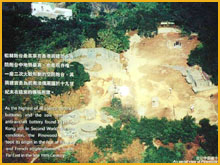
The Battle of Hong Kong

November 12th 2006 was Remembrance Sunday - the day Britain remembers its war dead and pays tribute to those who lost their lives in past conflicts. Having been brought up the U.K., I was taught a lot about WWII at school and of course U.K. popular culture has covered those events extensively in films and television programmes.

As 'bbcs', I think it's fair to say that we know quite a lot about the war from Britain's perspective but almost nothing about the war from an Asian perspective. This is something I wanted to address.

For example, it recently dawned on me that I knew nothing about WWII history in relation Hong Kong. I kind of promised myself to look into it and find out more about that period in history and I was pretty shocked at what I discovered after just a few minutes of searching.

Surprising fact no. 1: Japanese forces launched their attack on Hong Kong less than 8 hours after they bombed Pearl Harbor. It's a little shocking to me that the Pearl Harbor attack is an ingrained part of my general knowledge - everyone knows about Pearl Harbor, right? - and yet I had no idea about the Hong Kong attack until a few days ago.

British, Canadian and Indian forces did their best to repel the Japanese attack, but their air force was decimated, most of the defences were geared towards a naval attack and they were outnumbered two to one on the ground.

The Battle of Hong Kong lasted 18 grueling days before the British governor surrendered at a meeting in the Peninsular Hotel on December 25th, 1941. Yep, Christmas Day. Yep, that Peninsular Hotel. Where Felix is.

An account of the military action can be found here.


Surprising fact no. 2: Hong Kong was under Japanese rule for 3 and a half years. Again to my shame I hadn't really been aware of this part of Hong Kong's history. Japanese General Rensuke Isogai became the first Japanese governor of Hong Kong after the British surrender and remained so until the Japanese themselves surrendered on August 15th 1945, after the Hiroshima and Nagasaki bombs.

During the occupation, Hong Kong continued to be a bilingual island but the languages were Chinese and Japanese, not English. Shop signs and street names were changed accordingly. Lane Crawford had its named changed to Matsuzakaya. The Peninsula Hotel became the Matsumoto.

Over 2000 people living in Hong Kong who were of Allied nationality were placed in an internment camp in Stanley.

The Hong Kong Dollar was outlawed and being caught with HKD would result in torture. Locals were forced to exchange their HKD for Japanese war currency. But this currency became further and further devalued as the war progressed and was ultimately declared worthless. This meant Hong Kong citizens who no longer had their original HKD were made completely destitute.


Surprising fact no 3: Hong Kong's citizens endured war crimes and tyranny during the Japanese occupation. I had always associated Japanese war crimes with mainland China (the much debated Nanjing Massacre, for example) and had no clue that similar incidents took place in Hong Kong.

It is reported that the day of the British surrender, Japanese troops tortured and killed injured soldiers and medical staff at St. Stephen's College, a field hospital (http://ststephen.org.hk/History.htm)

Entire villages were destroyed by the Japanese; Cheung Sheung is one where only a trace remains. Thousands were repatriated to China. Death by starvation caused by a mis-managed economy were common, and dissent and rebellion were punished by torture and death.

Reliable figures are hard to come by but there are reports that up to 10,000 rapes may have been committed by Japanese troops in the early stages of the invasion and the total population of Hong Kong is known to have dropped from 1.6 million to around 600,000 by the end of the occupation.

Surprising fact no. 4: Hong Kong had it's own WWII resistance fighters. Some did fight back. The Gangjiu Da Dui Guerillas gained a foothold on Lantau Island and were able to intercept Japanese intelligence as well playing a central role in the rescuing dozens of Allied nationals, including 20 Brits.

The Dongjiang Guerillas came from Guangdong and were mostly peasants, students, and seamen. After the British retreat, the guerilla force numbered 6000 and established bases in the New Territories and Kowloon. They protected traders in Kowloon and Guangzhou, killed those they believed to be collaborators, and attacked Japanese bases at Tai Po and Kai Tak Airport. They also rescued Allied prisoners-of-war (Sir Douglas Clague, Professor Gordan King, David Bosanquet) as well as twenty American pilots who parachuted into Kowloon when their planes were shot down by the Japanese.

Little seems to have been recorded about the Hong Kong WWII resistance movement and details are sketchy.

Here are a few links for further reading:

Hong Kong Veterans Commemorative Association

A recent protest in Hong Kong called for Japan to acknowledge and apologise for its actions in Hong Kong during WWII.

Japanese tourists came to Hong Kong to learn more about the events surrounding the occupation.

Wikipedia summary: 'The Battle of Hong Kong'

The Chinese Alliance for Commemoration of the Sino-Japanese War Victims

Answers.com: 'The Japanese Occupation of Hong Kong'

A military view of the ill-fated battle


Well that's my attempt to provide a very condensed 'primer' about Hong Kong during WWII. I hope it's been useful. I have to admit that I was little ashamed at how little I knew about this episode in history and I'm glad I started researching it. After all, this all happened just 65 years ago.